Gjallarhorn F
Compact Continuity™ S Speaker Amp
$299.00 – $329.00
In stock
Description
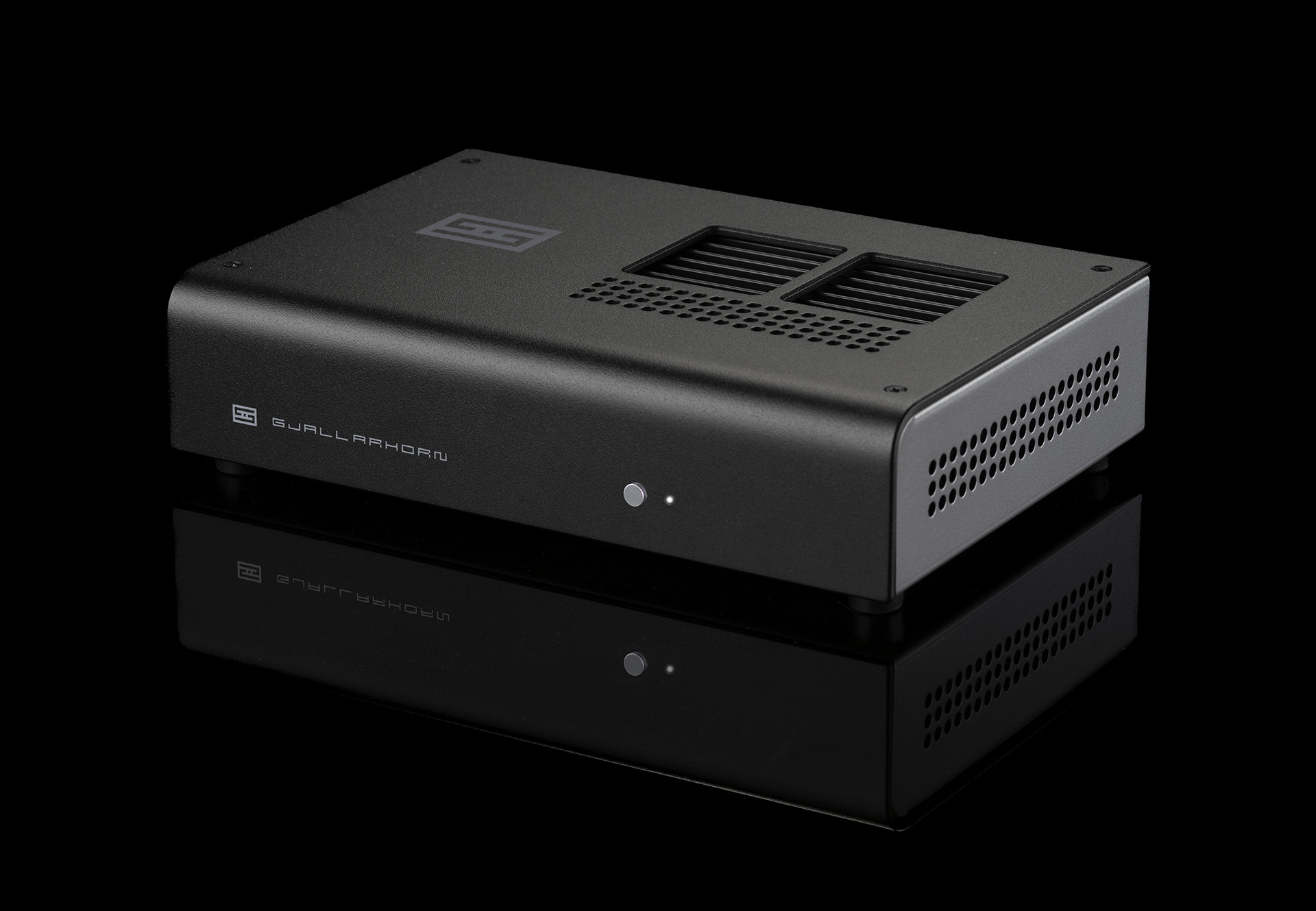
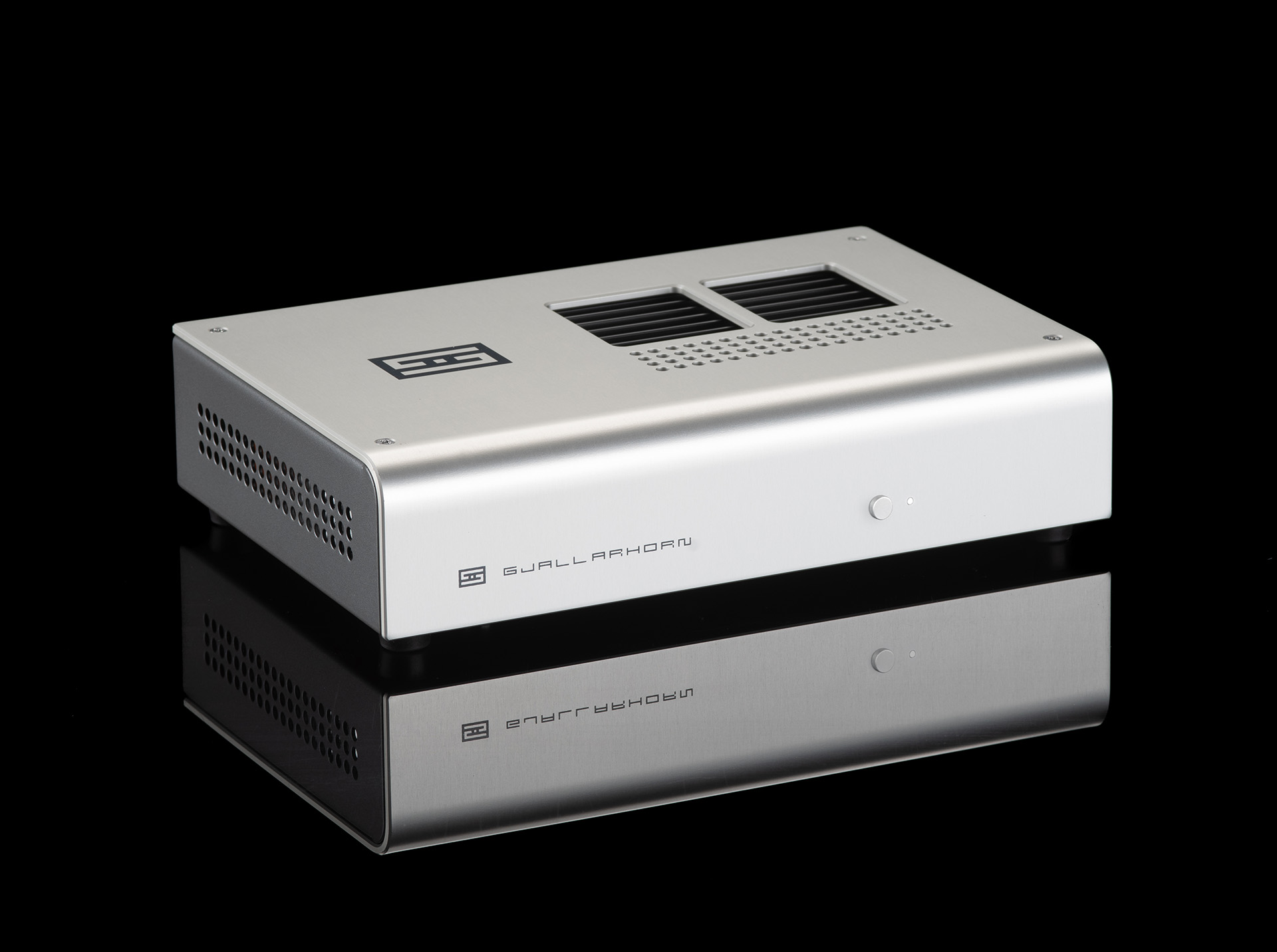
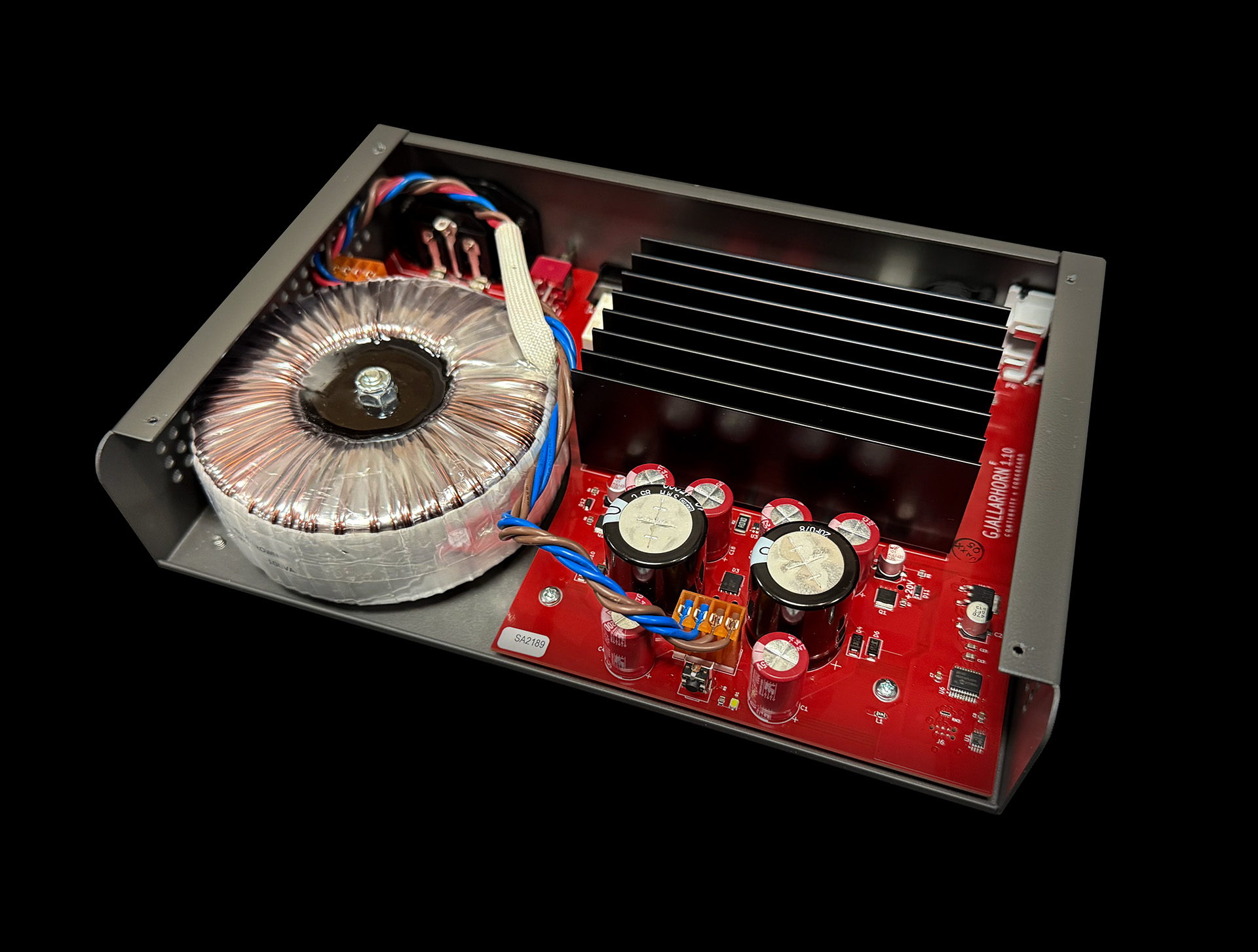
Ever wanted an ultra-high-end speaker amp—in a compact size perfect for desktops and smaller rooms? Have you wished for a dead-silent, no-hiss amp for nearfield listening—that’s still capable of driving most speakers to lease-breaking levels? Wish no more. Welcome to Gjallarhorn. Less Power, More BetterThere are plenty of big-number amps out there, but how much of that do you really use? How loud before the neighbors complain? How old does the constant hiss of a high-gain amp get with the speakers a few feet away? Gjallarhorn was designed to deliver exceptional performance, without the downsides. Or, as we put it: less power, more better. Exotic, Fully Discrete TopologyGjallarhorn may be smaller than our other amps, but that doesn’t mean it skimps on quality. It features an exotic, fully discrete, current feedback gain stage with our exclusive Continuity S™ output stage, as well as a fully linear power supply—including a toroidal transformer with stacked rails and 30,000uF of filter capacitance. No Class D, no switching supplies, no fans. Pick it up—it’s a heavyweight! Forkbeard™: Power Output, System Health, Remote StandbyAdd Forkbeard to Gjallarhorn, and you'll get all the benefits of the only multi-product, multi-stack, unified control system. One app gives you complete visibility of instant power output, health alerts, remote control of Standby mode, and integrates with many other Schiit products for advanced capabilities like Visual Volume™. Flexible for Desktop and BeyondCombine Gjallarhorn with any of our headphone amps to add power for nearfield monitors, or pair with Saga 2 for an exceptional small-room system. Have balanced preamp outputs? You can use them with a pair of Gjallarhorns, for additional power and capability. Designed and Built in the USABy “designed and built in the USA" this is what we mean: the vast majority of the total production cost of Gjallarhorn—chassis, boards, assembly, etc—goes to US companies manufacturing in the US. Our chassis are made in California. Our PCBs are made in California or Nevada, and it all comes together in our San Antonio facility. 5-Year Warranty, Easy ReturnsGjallarhorn is covered by a 5-year limited warranty that covers parts and labor. And if you don’t like your Gjallarhorn, you can send it back for a refund, minus 5% restocking fee, within 15 days of receiving it.
Specifications
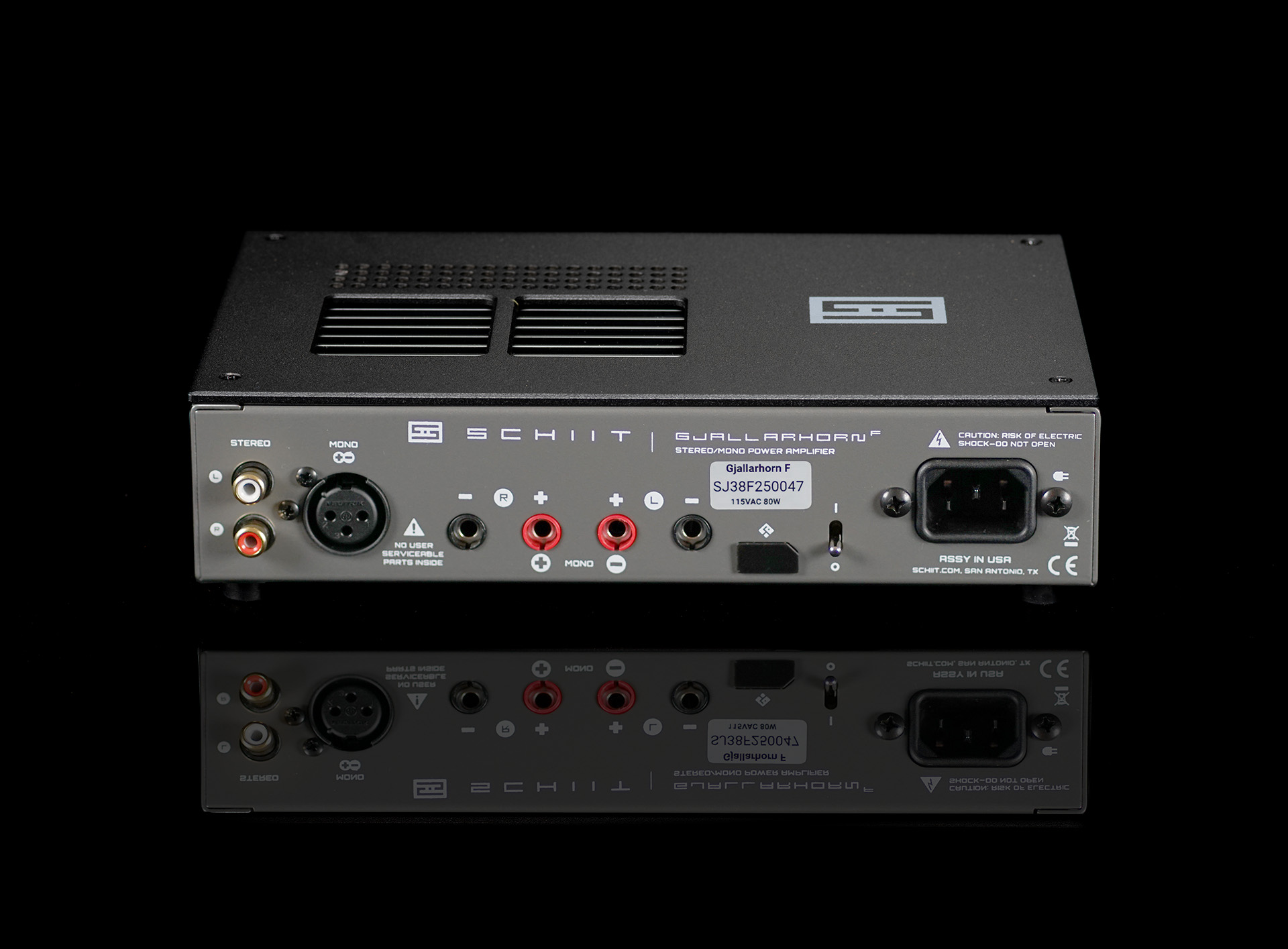
SPECS THAT MATTER Power: plenty for pretty much any speaker when used on a desk, and for most speakers when used in a roomNoise: insanely low, no hiss or hum even when used on a deskDistortion: inaudible, 10-100x lower than any speaker you're usingHeat: amp gets slghtly warm at typical volumesSize: same size as Asgard, Jotunheim, Bifrost 2; very desk-friendly OTHER SPECS Power Output: Stereo, 8 Ohms: 10W RMS per channelStereo, 4 Ohms: 15W RMS per channelMono, 8 ohms: 30W RMS Frequency Response: 20Hz-20Khz, +/-0.01db, 3Hz-500KHz, +/-3dB THD: <0.004%, 20Hz-20KHz, at 1V RMS into 8 ohms IMD: <0.005%, CCIR, at 1V RMS into 8 ohms SNR: >117dB, unweighted, referenced to full output Damping Factor: >100 into 8 ohms, 20-20kHz Gain: 10 (20dB) Input Sensitivity: AKA Rated Output (Vrms)/Rated Gain. Or, 9/20. You do the math. Input Impedance: 20k ohms SE, 40k ohms balanced Crosstalk: >80dB, 20-20kHz Inputs: L/R RCA jacks for stereo input, single XLR for mono input Topology: Continuity S output stage; fully discrete, fully complementary current feedback, no capacitors in the signal path Oversight: over-current and over-temperature sensors with microprocessor-based protection Power Supply: 80VA transformer, 30,000uF filter capacitance, plus boosted, CFP-regulated supply to input, voltage gain and driver stages Power Consumption: 80W maximum Size: 9” x 6” x 2.5” Weight: 8 lbs
FAQ
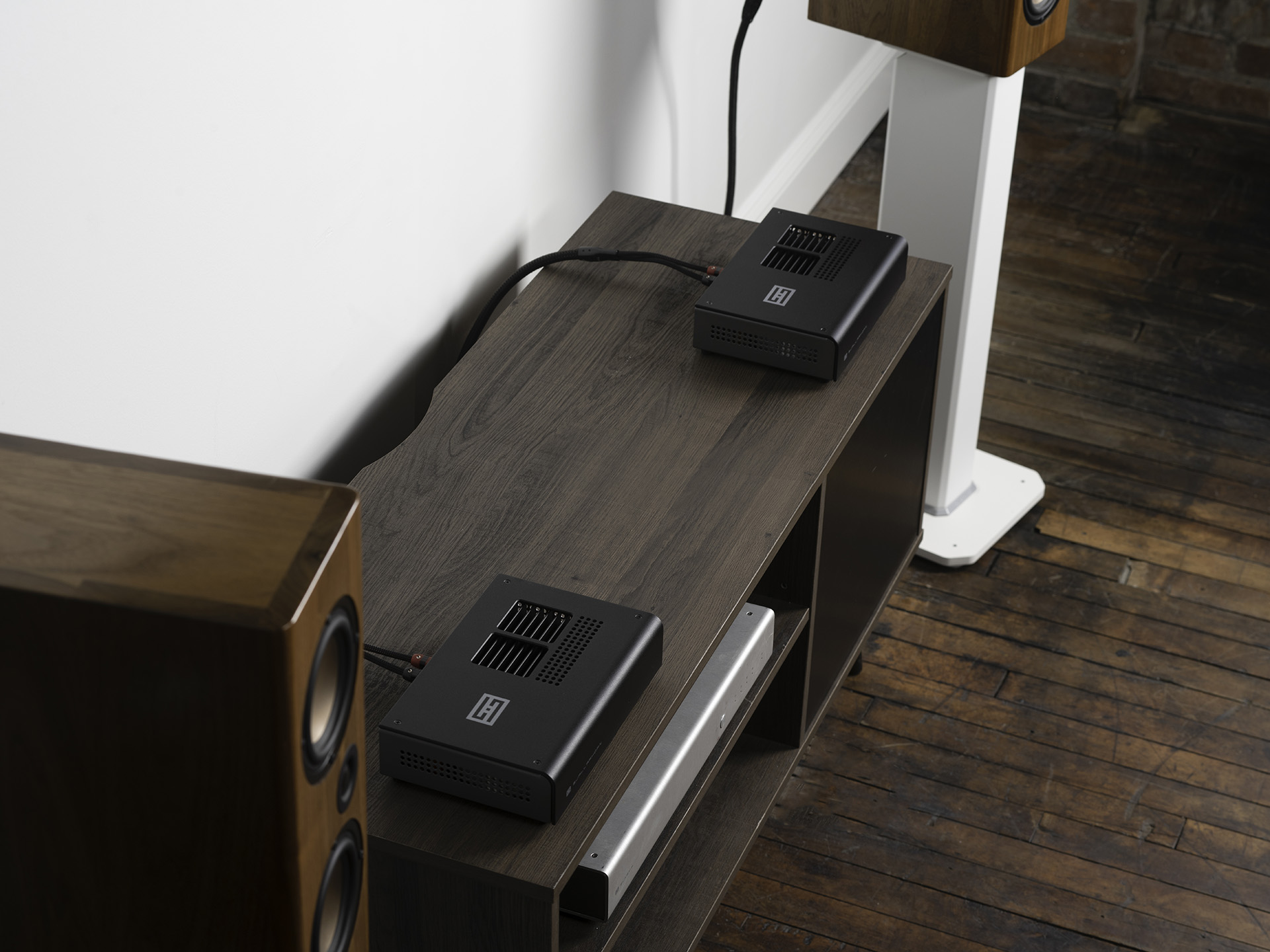
10W? That doesn’t seem like a lot.In an era where there are options that claim, like, a billion watts, from a box small enough to lose in the couch cushions, yeah, we hear you. This isn’t the amp to do party tricks like seeing if you can get to 115dB output in your stadium-sized living room. So what’s this amp for?For everyone who wants a super-high-quality amp for desktop, nearfield, and small room systems. But will it go loud?Put Gjallarhorn on your desk, connect it to any normal pair of speakers, and you’ll definitely get to leasebreaking levels, like, pronto. If you share walls, expect to hear the neighbors yelling to “turn it down!” What do you mean by “normal speakers?”Pretty much anything from a 2-way 4” bookshelf to refrigerator-sized horn speakers. As in, not planar speakers. Not what Eddie used to call “barking screens.” And not 2 ohm, 79dB efficient DIY jobbies. You know, normal speaker speakers that people buy on Amazon or at more hoity-toity kinda stores. So this is just a desktop amp?Nope! It’s perfectly capable for smaller rooms, too, especially if you have some of those refrigerator-sized horn speakers we mentioned previously. Or even smaller horn speakers. Fun fact: 10W out of Gjallarhorn with 95dB efficient speakers is like 100W out of Vidar into 85dB efficient speakers. Are you saying this could be the only amp I need?Maybe. For desktop duty, almost certainly. For smaller rooms, depends on your speakers. You’ll want to go with more efficient speakers if you want to get decent volume in a room setup. For more power, you could also double up Gjallarhorns and run them mono, or, if you’re really in doubt, Vidar is gonna be great for pretty much anything you throw at it. Can I stack this with your desktop headphone amps?Some of them, yes. It might get a little too hot sitting on top of an old Asgard 1, but Asgard 2, Asgard X, and any Jotunheim are usually fine (and the exact same size as Gjallarhorn.) In this case, you’d stack Gjallarhorn on top. It may not work so well in warm rooms (over 25 degrees C). Can I stack with your preamps?Saga 2 is a perfect match with Gjallarhorn F to create a mini-stack. You can run the same Forkbeard app the control both products. What does Forkbeard™ do?Forkbeard does everything a remote control does, but for multiple products in multiple stacks. For a preamp, it controls volume, selects inputs, picks output modes, etc. But it also does more, like show you power output on an amp, and system health alerts—temperature and current on an amp, for example, and tube heater status on a tube preamp. It can do even more when multiple products are brought together, like Visual Volume, an easy way to tell how much headroom you have left in your system. More info is available here: schiit.mom/forkbeard So is this kinda like a mini Vidar 2?Kinda. Ish. It has a more sophisticated output stage—Continuity S—than Vidar 2. But it uses different output devices. Beyond that, in broad strokes, they are similar. Similar gain stage, similar linear power supply, etc. The protection system on Gjallarhorn is all analog, though—no microprocessor—but still incorporates overcurrent, over-temperature, and DC protection. No class D?No. No switching supplies?No. Some of my friends are super into Class D and say it’s the future.There are plenty of Class D amps out there. Gjallarhorn isn’t one of them. Let me have a breakdown of the tech, using words of less than 6 syllables.Okay, here goes: Fully discrete, current feedback topology is amazingly fast (-3dB above 1MHz before input filter) and measures well, especially for such a simple stage. 2 pairs of 10A output transistors per channel, including one pair used for Continuity S stage to provide greater transconductance linearity. 100% DC coupled throughout, no capacitors in the signal path. Fully linear, all-internal power supply with 80VA toroidal transformer and 30,000uF filter capacitance in the main rails, plus 13,200uF for the boost rails. Separate discrete regulated boost rails improve efficiency and are ground-referenced (not stacked) to ensure each channel’s performance is independent from the other. Analog protection system uses a “least invasive methodology”—no active devices in signal path, no current limiting, no crowbars—just current and thermal sensor and DC servo. 4-layer PC board for optimal layout and current flow. No fan. You mentioned I could use these in monoblock mode. How does that work?It’s not a mode. It’s just the natural result of driving each channel with one half of a truly balanced signal. To use Gjallarhorn as a mono amp, you need a preamp with truly balanced outputs. A Jotunheim or Freya will do fine, as will any other source with a real balanced output. You don’t rate power for 4 ohms in mono. Why?Gjallarhorn will run 4 ohm speakers in mono just fine—up to a point. At which point, the over-current or over-thermal protection will kick in and your fun will end. That point is about 30W output, just like into 8 ohms. So not very exciting. If you need a ton more power, there’s always Vidar. So what’s a Gjallarhorn?Gjallarhorn, in Norse Mythology, is Heimdall’s “loud sounding horn.” And believe us, this is one loud sounding horn if you have any decent 5” 2-way speaker and neighbors living on the same wall opposite you!
Reviews
Schiit Gjallarhorn review – musically talented
hifizone.pl, Adam Kiryszewski/swordfish
"Schiit Gjallarhorn is a small footprint power amp with unique Continuity output stage that offers clear sound with great timbre."
Schiit Gjallarhorn review – musically talentedSchiit Gjallarhorn: A 10 Watt Amp That Sounds Amazing
Forever Analog, Hartley
"I found the Gjallarhorn to be a great sounding amp on my desktop, no matter the sensitivity of my speakers. Very easy to listen. Great sounding amp. Sounds great at low volumes."
Schiit Gjallarhorn: A 10 Watt Amp That Sounds AmazingThe Wait is Over!!! ! New Affordable Amp from Schiit - Gjallarhorn Review
The Audiophile Man, Paul Rigby
"If you have a job, use the right tools for that job, if you can. The Gjallarhorn amplifier is ideal for small room or on a desktop with a computer."
The Wait is Over!!! ! New Affordable Amp from Schiit - Gjallarhorn ReviewMore SCHIIT: Rekkr & Gjallarhorn Amp Reviews
Steve Guttenberg Audiophiliac